

1. About Cloud Dwelling Building
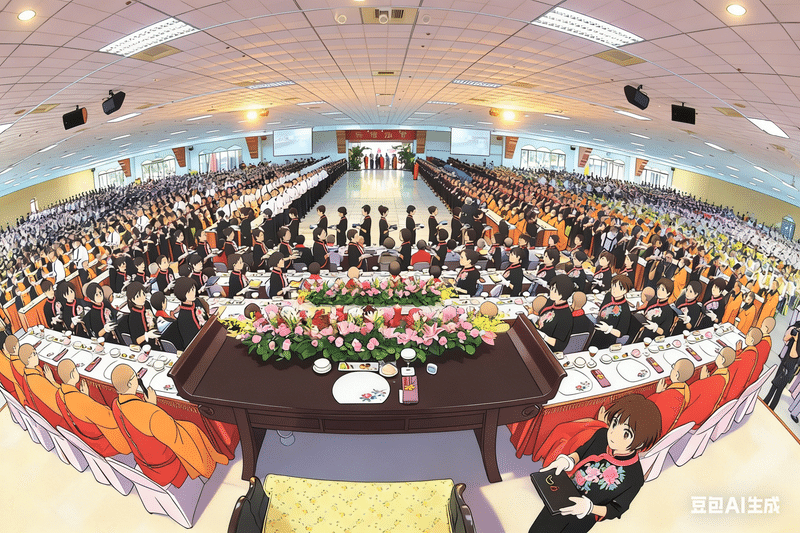
Located on the east mountain of Fo Guang Shan, the Cloud Dwelling Building overlooks the Gaoping River and Mount Kavulungan. Construction began in July 1994 and completed in January 1998. The eight-story, multi-purpose building provides accommodation and venues for Dharma discussions, acting as the center of Dharma gathering akin to Vulture Peak during the Buddha's time. The Dining Hall, also known as the Five Contemplations Hall, is located on the first floor. Covering an area of 36,000 square feet, it can serve 3,000 to 4,000 people during formal meals.
2. Formal Meal
Also known as "passing the hall," this refers to monastics partaking in formal meals in the dining hall. In the Buddha's time, they went on alms rounds, a practice now less feasible due to social customs. Thus, in Chinese monasteries, communal meals in the dining hall are observed as one of the Five Daily Practices, held in equal importance to morning and evening chanting.


3. Eating in a Buddhist Monastery
Before mealtime, the assembly signal is first struck as a preparatory cue, followed by the wooden fish, which hangs to the left of the dining hall entrance. Symbolizing continuous diligence, the wooden fish reminds everyone that mealtime is also a practice in mindfulness. At its sound, monastics line up and enter the dining hall.
The cloud board, named for its cloud-like shape, hangs to the right of the dining hall entrance and signals mealtime in Chan monasteries. The assembly signal, wooden fish, and cloud board are struck before breakfast and lunch to mark mealtime and also to serve as a reminder of mindfulness.
In Buddhist practice, daily cultivation is essential. During meals, monastics practice the Five Contemplations and Three Recitations, eating with a mind free of attachment and greed, viewing food solely as nourishment for the body.



4. Meal Offering Mantra
The "Meal Offering Mantra" is recited before breakfast and lunch to make offerings to buddhas and
bodhisattvas. Table service should serve the staple food (rice or noodles) before the end of the
mantra.
(Breakfast) Porridge has ten benefits, benefiting practitioners, with boundless rewards
and ultimate constant joy.
(Lunch) Three virtues and six flavors, offered to Buddha and sangha,
all sentient beings in the dharma realm, universally making offerings. When eating, may all beings
take meditation joy as food and be filled with dharma joy.
5. Monk's Chant
The karmadana chants: "Disciples of the Buddha, observe the Five Meal Contemplations while partaking your meal. If you indulge in idle talk and absent-mindedness, how can you be worthy of offerings from the devotees? Upon hearing the sound of the bell, observe mindfully," as a reminder that one should take the Dharma as nourishment for the path. The assembly answers, "Omitofo (Amitabha Buddha)," as a reply that they will uphold the teaching.

6. Origin of Food Bestowal
The attendant holds the food bestowal instruments, with the "blade" in the right hand and the "hand" in the left, symbolizing eradication of obstruction and offering of nectar, respectively. Receiving seven rice grains from the abbot, the attendant performs the rite at the food bestowal platform, making offerings to the suparna bird, the raksasa Hariti, and the deity Atavika. This compassionate act seeks to bring fullness and freedom from greed to hungry beings.

7. End of Meal
"One who has made offerings will certainly gain benefits. If one delights in giving, one will surely attain peace and happiness. After begging for meals, may all sentient beings accomplish their cultivation with all the teachings of the Buddha." This chant means that those who offered meals will receive virtuous merits, peace, and happiness. After mealtime, the assembly wishes all beings, cultivation, and offerings to be filled with the Buddha-Dharma and attain buddhahood together.

8. Why is Maitreya Bodhisattva enshrined in the Dining Hall?
The story of Maitreya Bodhisattva manifesting as Master Budai to receive offerings in the dining hall originates from a famous tale at Tiantong Temple in Ningbo.
One day, as the monastics were preparing for their formal meal, they were surprised to find Master Budai sitting in the abbot's seat. In a rush, the disciplinarian grabbed Master Budai by the ear to pull him away, but when he turned back, Master Budai was still sitting in the same spot. Startled, he let go, and the ear shrunk back to its original form. At that moment, the abbot arrived, recognizing Master Budai as a manifestation of Maitreya Bodhisattva. The abbot immediately offered his seat and took a place behind the bodhisattva.
This legend is the reason Maitreya Bodhisattva is enshrined in the dining hall.

9. Cultivation Department
Meal Preparing and Meal Service
The great quarters are where the meals are
prepared, and the directors of the kitchen are in charge of preparing the meals. Table service would
serve meals to the assembly. In Buddhism, meal preparation and service are considered cultivation
departments. As the sayings go, "Before attaining buddhahood, one must first develop affinities with
others;" "To be the leaders of Buddhism, one must first serve sentient beings." Many joyfully
volunteer in the kitchen and dining hall, cultivating merit and good affinities while integrating
the Dharma into daily life.


10. Eight Benefits of Partaking in Formal Meal with the Community
(1) Prevents Indolence
Formal meals prevent negligence in one's practice. Before mealtime, the signal board is struck three times. The first strike is a notice to prepare; the second signals putting on robes and entering the Dining Hall in order; the third signals quietly awaiting the abbot's arrival.
(2) Efficient Offering
Kitchen and table service conserve effort as arranging bowls, serving food, and cleaning are organized and swift.
(3) Equality and Selflessness
Everyone eats the same food without distinction between senior and junior monks, actualizing Buddhist equality and non-self.
(4) Balanced Diet
Equal portions of various foods ensure balanced nutrition, benefiting health and helping correct unwholesome habits.
(5) Partaking in Shared Meals
All foods are accepted without preference or rejection, tasting everything as nectar, eliminating discrimination and bringing dharma joy.
(6) Mindfulness of Existence
Maintain mindfulness, contemplate that offerings are difficult to repay, regard food as medicine, and let arising thoughts go immediately.
(7) In Accordance with the Dharma
As monasteries grew, especially during ordinations, rules for formal meals prevent chaos. Discipline brings peace of mind and supports cultivation, embodying the spirit of Buddhist education.
(8) Dignified Comportment
Buddhist disciples exhibit dignity even when eating; orderly dining inspires joy and respect. A couplet in the Five Contemplations Hall reminds: "Eating with Five Contemplations, even gold can be digested. If the Three Minds are not eliminated, even water cannot be stomached."
Basic Rules for Formal Dining
"Dragon holding pearl, Phoenix nodding" symbolizes all beings possess Buddha‑nature like a
precious jewel.
Hold the bowl with the left hand and use chopsticks with the right hand to bring food to the
mouth with gentle, quiet, and dignified movements.
1. No mobile phones / No talking / No photography / No takeaway food.
2. No walking around — wait until the end of the meal to stand up and leave
your seat; you may continue eating if unfinished.
3. Return dishes, rice bowls, soup bowls, and fruit in order. Once served, food
and drink must be consumed.
4. Returning food — If allergic or portions are too large, leave bowls/plates
at the table edge for servers to reduce portions (not due to likes/dislikes).
5. Adding food — To add rice, place the rice bowl crosswise back to its
original upper‑left position; to add dishes, push the plate to the table edge.